
Not every caregiver begins with a plan to enter the field. For Jodie, the path to caregiving grew out of family, loss, and the kind of decision many families eventually face. After spending 30 years in an instructional career, she found herself helping care for her husband’s parents as their health declined—her mother-in-law in the later stages of dementia and her father-in-law living with Parkinson’s and early dementia. Faced with the difficult choice so many families know well, she and her husband chose to keep them at home, and she stepped into the role full time.
They were able to care for them at home until each of them passed away, and in that process, she discovered something unexpected: The work was deeply meaningful. What began as a family decision became a turning point.
Her official start in caregiving came during the height of COVID, when a best friend who had spent her life working in a nursing home encouraged her to get involved. What began as an attempt to volunteer turned into a job when the facility explained that outside visitors were not allowed during the pandemic, but employees could still be part of residents’ daily lives. She joined a Fort Wayne nursing home and rehab center, where she often worked on the COVID unit during one of the most difficult and heartbreaking periods in healthcare.
Eventually, a move led her to Senior1Care.
“I could not dream of a better company,” Jodie said. “Not just to work for, but also what we are able to provide for our clients. From training and continuing education to the support of an in-house nurse, Senior1Care gives caregivers the tools they need to do the job well and feel supported from day one.”
For her, though, the real reward is in the relationships. Jodie says caregiving offers the profound satisfaction of knowing she is making a tangible difference in someone’s life. The companionship often becomes a deep emotional bond, and she finds joy in helping clients maintain dignity, comfort, and a sense of purpose while remaining in their own homes.
That sense of purpose carries into the everyday moments that might seem small from the outside but mean everything to the person receiving care. She loves being outdoors, reading, gardening, and spending time at the lake, and often finds ways to share those interests with clients. If a client can no longer read easily, she reads to them. If they love gardening but cannot physically do the work, she lets them serve as “project managers” while she helps bring their ideas to life. For her, the best caregiving often comes from finding ways to preserve the activities and routines that still make life feel like their own.
She also believes caregiving takes a certain kind of person: “I personally absolutely think it takes a person with a big heart and a lot of patience,” she said. “If you have the compassion and the desire to help people, and it makes you feel good seeing them feel good, you’re aiming for the right career.”
If there is one thing she wishes more families understood, it is that receiving help does not mean giving something up; it often means getting something back.
Because she has lived it herself, she speaks candidly about what happens when adult children become full-time caregivers for their own parents. The relationship can change. Time together starts to revolve around medications, bathing, bills, cleaning, and stress rather than simple connection. That, she says, is where home care can make such a difference.
“When companies like Senior1Care can step in and say, ‘Let us do the work,’ then when you’re there, you sit down, you visit, and you be the child,” she said. “You spend time with mom or dad and just enjoy them.”
She also knows the work comes with a heartbreak that not everyone sees. When clients pass away, the loss is real.
“They become your family,” she said. “It is absolutely a blessing to be a part of this end journey. But at the same time, it’s always hard to say goodbye.”
Even with that heartbreak, she never questions whether this is the work she is meant to do.
After retiring for two years while helping care for her husband during a season of health issues, she thought she might return to caregiving just a couple nights a week. Instead, she found herself once again deeply invested in work she loves—often averaging far more hours than planned because she has a hard time saying no when someone needs help.
That same energy and sense of purpose carry into the rest of her life as well.
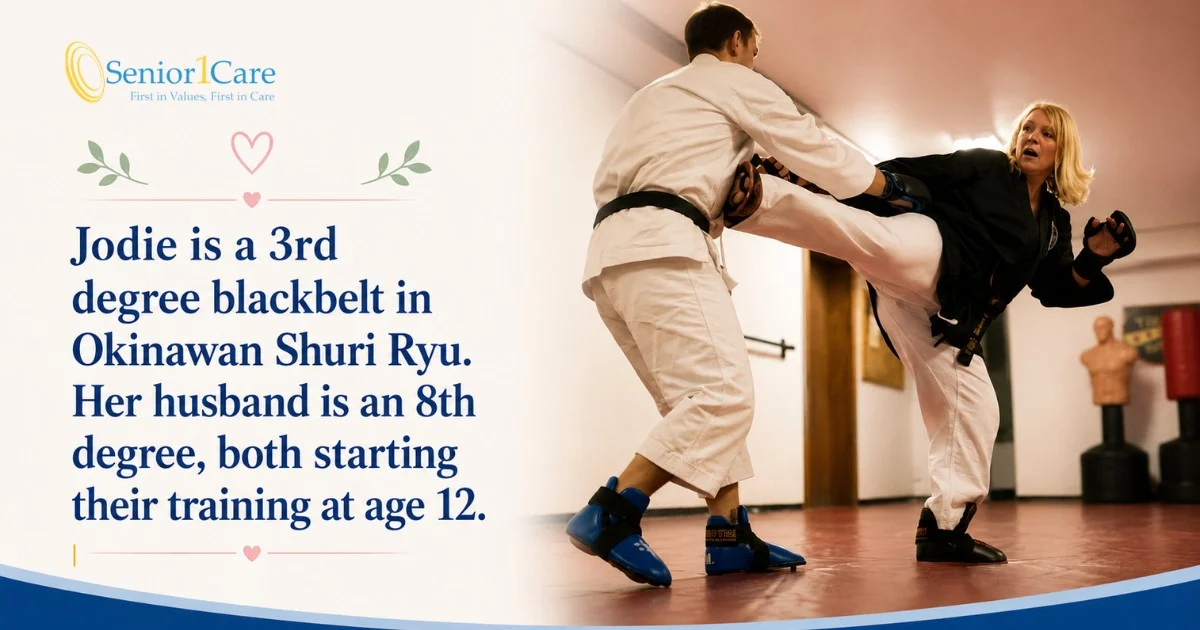

Outside of work, she enjoys hiking, gardening, reading, and spending time with her husband, Jay Thompson, a retired Fort Wayne police officer of 33 years. The two also share a lifelong interest in martial arts and have offered free self-defense training in the community, a detail that may surprise some of the clients and coworkers who know her best, but one that reflects the same spirit of service and generosity that runs through so much of her life.